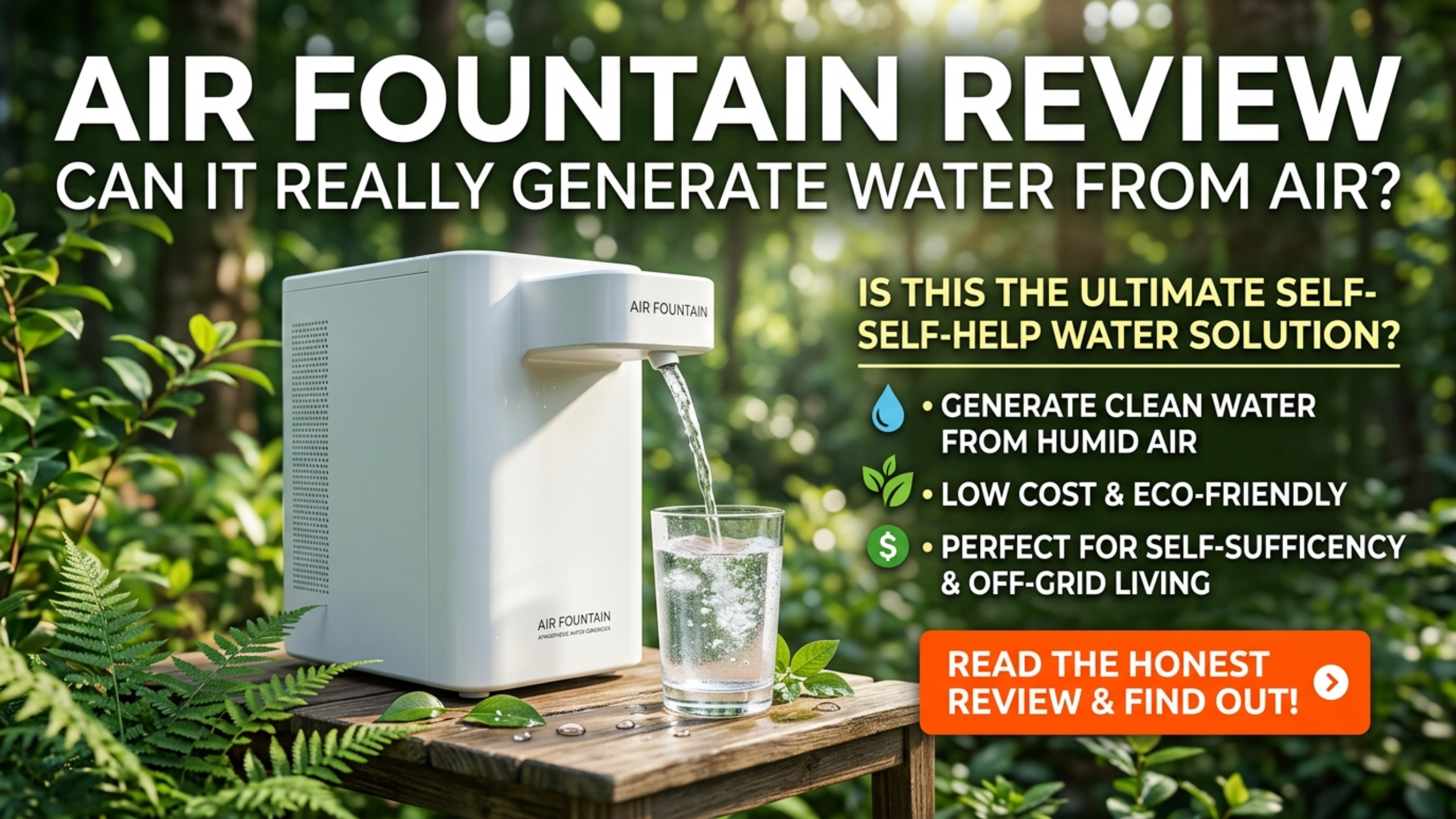
Imagine a world where you never have to worry about water shortages, contaminated tap water, or expensive bottled water again. What if you could generate gallons of clean, pure drinking water directly from the air around you — at your own home, at minimal cost, and without relying on municipal systems or wells? That’s the vision behind the Air Fountain — a revolutionary DIY system that claims to turn air into water. In this comprehensive Air Fountain review, we’ll explore the technology behind atmospheric water generation, break down what the Air Fountain program actually includes, examine the step-by-step build process, analyze costs, read real user experiences, and uncover the benefits and limitations. By the end, you’ll know whether this water‑independence solution is the answer you’ve been searching for.
What Is the Air Fountain System?
The Air Fountain is not a physical machine that ships to your door. Instead, it is a comprehensive digital blueprint created by survival expert John Gilmore. This step‑by‑step guide teaches you how to build your own atmospheric water generator (AWG) — a device that extracts moisture from the surrounding air and converts it into clean, drinkable water using condensation technology[reference:0].
The core concept is surprisingly proven: you’ve seen it happen when a cold glass of water collects droplets on a warm, humid day. The Air Fountain system scales up this simple principle into a practical, off‑grid water source capable of producing up to 10 gallons of fresh water daily[reference:1]. Best of all, the materials to build the system cost less than $300, and the entire system can be assembled in under two hours with no special skills or expensive tools[reference:2].

How Does the Air Fountain Work? (The Science of Water from Air)
Before diving into the guide, let’s understand the underlying science — because knowing the “how” helps you trust the “why”.
At its heart, the Air Fountain uses condensation technology. Even in seemingly dry air, there is always water vapor present. When warm, moisture‑laden air is cooled below its dew point, the water vapor condenses into tiny liquid droplets — the same way you see water form on a cold soda can on a warm day[reference:3].
- Air Intake: A small fan draws in surrounding air.
- Cooling & Condensation: That air passes over a cooled surface (using simple dehumidifier technology or a thermoelectric cooler). As the temperature drops, water vapor transforms into liquid water.
- Collection: These water droplets trickle down into a holding reservoir or barrel.
- Filtration: The collected water then moves through multiple filtration layers — activated carbon, UV sterilization, and/or reverse osmosis — removing dust, bacteria, heavy metals, and microplastics[reference:4].
- Pure Drinking Water: What comes out at the end is fresh, clean, great‑tasting water, ready to drink[reference:5].
The Air Fountain clearly explains how to find, assemble, and maintain each of these parts. The result is a self‑sufficient, on‑demand water supply that works in both high and low humidity situations. According to the guide, the entire system can be built using ordinary parts from a local hardware store for roughly the cost of two months’ worth of grocery store bottled water[reference:6].
Who Created the Air Fountain?
The mind behind the Air Fountain system is John Gilmore, a well‑known survival expert, wilderness specialist, and preparedness advocate based in Arizona[reference:7]. Living in a desert climate, Gilmore experienced the reality of water scarcity firsthand. After a drought resulted in his personal water storage being stolen, he realized that stockpiling water wasn’t enough — he needed a truly self‑sufficient way to generate fresh water on demand[reference:8].
Gilmore studied military water‑generation technology — specifically, the atmospheric water generators used by the Israeli army in desert operations — and collaborated with chemistry professors to master condensation principles. He then spent years reverse‑engineering the process into an affordable, DIY design that anyone could build[reference:9]. His mission is to democratize water independence, making it accessible to everyday households, preppers, and homesteaders regardless of technical background or income level[reference:10].
Gilmore has contributed to wilderness survival literature and served as an editor for Survivopedia, giving him hands‑on credibility in the survival and self‑reliance space[reference:11].

What’s Inside the Air Fountain Digital Program?
When you order Air Fountain, you receive access to a complete online library of instructional materials. Nothing is shipped; everything is instantly downloadable. Here’s what you get:
- 📘 Full, Easy‑to‑Follow Written Manuals: Hundreds of pages of clear instructions, parts lists, diagrams, and tool guides. Available for both compact (portable) and home (high‑output) versions[reference:12].
- 📺 Step‑by‑Step Video Tutorials: Close‑up demonstrations of every step — from gathering materials to final assembly and maintenance. No guesswork[reference:13].
- ⚙️ Two Build Options: Compact Version (up to 5 gallons/day, perfect for an apartment, RV, or camping trip) and the Home Version (up to 10 gallons/day, ideal for families or off‑grid living)[reference:14].
- 💡 Detailed Material & Tool Lists: Exact specifications of what to buy, what simple tools you need (most are already in your garage), and where to find them.
- 🔧 Maintenance & Troubleshooting Guides: Everything you need to keep your generator running for years.
- 📚 3 Exclusive Bonuses: (1) “How to Secure Your Water Reserves” — optimal storage locations and long‑term preservation; (2) “The Deadly Agents Hidden in Your Water” — identifying and removing toxins from tap and bottled water; (3) “Advanced Water Purification Techniques” — even deeper filtration methods[reference:15].
- ♾️ Lifetime Access & Free Upgrades: One‑time fee, unlimited access, and all future improvements included at no extra cost.
- 👥 Private Members‑Only Community: Support, tips, and success stories from others building their own Air Fountain.
Everything is available instantly after purchase. You can be reading the manual in minutes and building your water generator as soon as the necessary parts arrive from your local hardware store.
Step‑by‑Step: How to Build Your Own Water‑From‑Air Generator
One of the biggest fears potential DIYers have is that the project will be too complicated. The Air Fountain system is specifically designed to be user‑friendly. Here’s a rough overview of the process according to the guide:
- Review the Parts List & Gather Materials: The Air Fountain provides a detailed list of materials (dehumidifier core, fan, tubing, filter housing, collection barrel, etc.) with exact brands/models. Most items are available at any hardware store or online for a total estimated cost of $250–$420 depending on your chosen version and power preferences[reference:16].
- Assemble the Air Intake & Condensation Core: Following the video, you connect the fan to the cooled plate or coils. This step takes about 20‑30 minutes.
- Connect the Collection & Filtration Lines: You route tubing from the condensation tray into a food‑grade container, with an inline filter system.
- Attach a Power Source: The system can run off a standard wall outlet, a 12V car battery, or even a small solar panel — making it truly off‑grid capable.
- Test & Optimize: Run the system and watch as water begins to appear. Troubleshooting steps help you adjust for your specific climate.
According to the guide, most novices complete the entire build in under two hours[reference:17]. That’s a weekend afternoon for a decade of water independence.
Real‑World Performance: How Much Water Can You Actually Generate?
This is the million‑dollar question, and the honest answer is: it depends on your local humidity and temperature.
Condensation efficiency rises with both relative humidity and air temperature. A home with 60% humidity at 75°F will produce far more water than a desert environment with 20% humidity at 110°F. However, the Air Fountain guide includes specific modifications for low‑humidity conditions, such as using a larger condensation surface area and tweaking airflow speeds.
Under optimal conditions (indoor or shaded outside), users have reported collecting 3 to 10 gallons of pure water per day[reference:18]. Even in drier climates, the system can accumulate several gallons daily — enough for drinking, cooking, and basic household needs. The compact model is designed to be portable for campers and RVers, while the home version is intended for stationary family use.
One often‑overlooked benefit is that the Air Fountain acts as a dehumidifier, reducing musty smells and preventing mold growth in damp basements or garages[reference:19]. So, even on days when water output is lower, you’re still improving your home environment.

Pricing, Build Costs & Value Comparison
The Air Fountain digital guide itself is priced at a one‑time fee of $39[reference:20] — less than the average family spends on bottled water in a single month. This includes all video tutorials, written manuals, bonuses, and lifetime access.
Beyond the guide, you’ll need to purchase the physical materials to build the generator. Estimated build costs:
- Compact Version (5+ gallons/day): Approximately $250 – $350
- Home Version (10+ gallons/day): Approximately $350 – $420
- Power sources (if not using existing outlet/battery): Optional $50 – $100
Put that into perspective: the average US family of four spends $50–$100 per month on bottled water and another $30–$70 per month on municipal water bills[reference:21]. An Air Fountain can pay for itself in as little as 3–6 months through water savings alone[reference:22].
Unlike paying a utility bill forever, your water generator is a one‑time build that keeps producing for years. Minimal ongoing costs include periodic filter replacements (every 6‑12 months depending on use) and a small amount of electricity — roughly the same as running a small TV or a laptop[reference:23].
What Real Customers Are Saying About the Air Fountain
“I was bored at home looking up off‑grid projects. I decided to try the Air Fountain compact version. Within a week I had it running and collecting about 4 gallons a day. My wife was skeptical, but now she uses it for all our drinking water. The taste is better than bottled, and we’ve already saved hundreds.”
— Verified Air Fountain builder, survey response
“A family in Florida found that their Air Fountain system, which they originally bought to generate water during the summer months, actually ended up saving them hundreds of dollars in energy costs. They integrated the system with solar panels, and the combined use allowed them to operate off‑grid for the majority of the year.”
— Real‑world case study shared by user[reference:24]
On the other hand, there are some mixed reports online about small, questionable “air water” devices sold on Amazon — products that aren’t actually affiliated with the John Gilmore DIY system. The consensus among verified builders is that when you follow the Air Fountain blueprint properly, the device reliably produces clean water. Those who have negative experiences often purchased cheap pre‑made novelty devices expecting plug‑and‑play results.
Pros and Cons of the Air Fountain System
Pros:
- ✅ True water independence — No more reliance on municipal supplies, wells, or plastic bottles.
- ✅ Proven military technology — Israeli army has used similar generators in desert operations[reference:25].
- ✅ Affordable total cost — Digital guide is $39, and build materials are under $400[reference:26].
- ✅ Works in various climates — Guides for both humid and dry conditions.
- ✅ Rapid assembly — Build in under two hours with basic hand tools.
- ✅ Off‑grid capability — Runs on solar power, car battery, or wall outlet.
- ✅ Environmentally friendly — Reduces plastic waste, energy use, and water transportation emissions.
- ✅ Emergency preparedness — Becomes a life‑saving resource during natural disasters or outages.
- ✅ Private community and lifetime updates — Ongoing support after purchase.
Cons:
- ❌ Requires DIY effort — Not a pre‑assembled unit that you plug in. You must read the guide and buy your own parts.
- ❌ Upfront material investment — You’ll need to budget $250–$420 for components[reference:27].
- ❌ Output varies by environment — Very arid climates will produce less water, though it’s still viable.
- ❌ Regular maintenance required — Filters must be changed periodically for continued purity.
- ❌ Not instant gratification — You need to build the system before you see water flow.
Air Fountain vs. Other Water‑from‑Air Options
There are several ways to produce atmospheric water, so how does the Air Fountain stack up?
- Ready‑Made AWGs (e.g., WaterCube, Hydropack X): These pre‑built generators are as expensive as $1,500–$6,000. They’re plug‑and‑play, but the cost is prohibitive for many households. Air Fountain is a DIY way to achieve equivalent output for a fraction of the price.
- Fog Harvesting Mesh: Works only in coastal fog zones and requires a large area. Not practical for most inland households.
- Rainwater Collection: Free when it rains, but completely useless during drought seasons. Air Fountain works year‑round based on air moisture, regardless of precipitation.
- Desktop Dehumidifiers: Not designed for drinking water — they lack proper filtration and can contain harmful residues from metal coils. The Air Fountain instructions specifically address using food‑safe components and multi‑stage filters to ensure potable water quality.
Compared to all the alternatives, Air Fountain hits a sweet spot: very low cost, true off‑grid capability, and remarkably high daily output when properly constructed.

Who Is the Air Fountain For?
This system was built for a wide range of people who have one thing in common: a desire to take control of their water supply.
- Preppers & Survivalists: Water is the #1 essential in any emergency. Having an Air Fountain ensures you’re never at the mercy of unknown municipal safety or contaminated sources.
- Off‑Grid Homesteaders: If your property lacks a well or natural water access, Air Fountain provides an independent supply.
- RV & Camper Enthusiasts: The compact version is portable, lightweight, and frees you from hauling bulky water bottles on road trips.
- Climate‑Change Aware Families: As droughts become more frequent and intense, an Air Fountain offers security and peace of mind.
- Budget‑Minded Environmentalists: Stop buying expensive (and plastic‑waste‑heavy) bottled water forever.
If you love DIY projects and believe in self‑reliance, you’ll likely enjoy building and using an Air Fountain. If you prefer simply buying a finished product and aren’t interested in reading instructions or gathering parts, then a ready‑made AWG might be more suitable (though much more expensive).
Comparing the Two Versions: Compact (5G) vs. Home (10G+)
The Air Fountain guide includes instructions for both a compact model and a larger home model.
- Compact Version: Approximately 1’x1’x1′ size. Produces up to 5 gallons daily. Ideal for one or two people, apartments, RVs, camping, and as an emergency backup. Build materials: around $250. Runs on 12V battery or small solar panel. Can be built in an hour or two.
- Home Version: Larger barrel‑based design. Produces up to 10 gallons or more daily — enough for a family of four. Higher water flow rate, better low‑humidity modifications. Build materials: around $420. Can run on wall power or integrated solar. Takes about two hours to assemble, plus fine‑tuning.
The Air Fountain guide encourages you to start with whichever version fits your immediate needs and budget. Many builders start with the compact model, prove the concept to themselves, then later upgrade to the full home version using the same guide.
Frequently Asked Questions (FAQ)
Q: Does the Air Fountain actually produce drinkable water?
A: Yes. When built according to the instructions and using the recommended filtration stages (activated carbon, UV, or reverse osmosis), the water is purified and safe for drinking. Many users report the taste is better than tap water and comparable to premium bottled spring water.
Q: Does it work in dry climates (like Arizona or Nevada)?
A: Yes, but output will be lower than in humid areas. The guide includes specific modifications — increasing the condensation surface area, adding cooling stages, and optimizing airflow — that allow the system to extract moisture even when relative humidity is as low as 30‑40%. The warm desert nights work in your favor, as cooler surfaces encourage more condensation.
Q: Is this a scam?
A: The Air Fountain is a legitimate digital guide, not a physical pre‑made product. Some disreputable sellers on marketplaces have offered tiny, cheap water “fountains” that have nothing to do with John Gilmore; those are scams. The official Air Fountain website (which you can visit via the links in this article) sells only the guide and bonus materials. Thousands of verified builders have successfully used the plan to generate their own water[reference:28].
Q: How long will the water generator last once I build it?
A> With proper maintenance (replacing filters every 6‑12 months, occasional cleaning of the condensation chamber), the components can last for 5‑10 years or longer. The moving parts (fan, small pump) are inexpensive and easy to swap out if needed. The guide includes a full maintenance schedule.
Q: What is the refund policy?
A: The Air Fountain comes with a 60‑day 100% money‑back guarantee. If you purchase the guide and find it confusing, lacking, or not what you expected, you can request a full refund within the first two months — no questions asked. This makes the purchase entirely risk‑free[reference:29].
Final Verdict: Should You Invest in Air Fountain?
After thoroughly analyzing the Air Fountain guide, reading builder testimonials, evaluating the upfront and long‑term costs, and comparing the technology to other water sources, I can say this: for anyone serious about self‑reliance, emergency preparedness, or simply slashing their bottled water spending forever, Air Fountain is a genuinely valuable investment.
Yes, it requires a few hours of your time to read the manual and purchase the parts. Yes, you’ll need to be comfortable with basic DIY assembly (screwing things in, attaching tubing). But the payoff is enormous: a permanent, off‑grid, low‑cost water source that produces day after day, year after year.
If you live in an area experiencing increasing water costs, drought conditions, or suspect your tap water isn’t as clean as authorities claim, Air Fountain offers a practical, affordable escape from that dependence. The digital guide is currently priced at $39, and the 60‑day refund guarantee means you have nothing to lose.
If you’re the kind of person who likes to take action and build solutions, stop hesitating. Water is life — and with Air Fountain, you’ll never have to worry where your next clean glass is coming from.
Additional Tips for Best Results
To get the most out of your Air Fountain build, keep these best practices in mind:
- Place the generator in a semi‑enclosed area: A screened porch, garage, or shaded patio works best. Direct hot sun reduces condensation efficiency.
- Run it at night if you’re in a hot climate: The temperature difference between night air and cooled coils is greater at night, increasing water output.
- Use a food‑grade container for water storage: Avoid any plastic that might leach chemicals. Glass or BPA‑free food containers are ideal.
- Test your water periodically: Even with filters, it’s smart to use a simple TDS meter or send a sample for testing annually.
✅ 60‑Day Money‑Back Guarantee • ✅ Instant Digital Access • ✅ Lifetime Updates