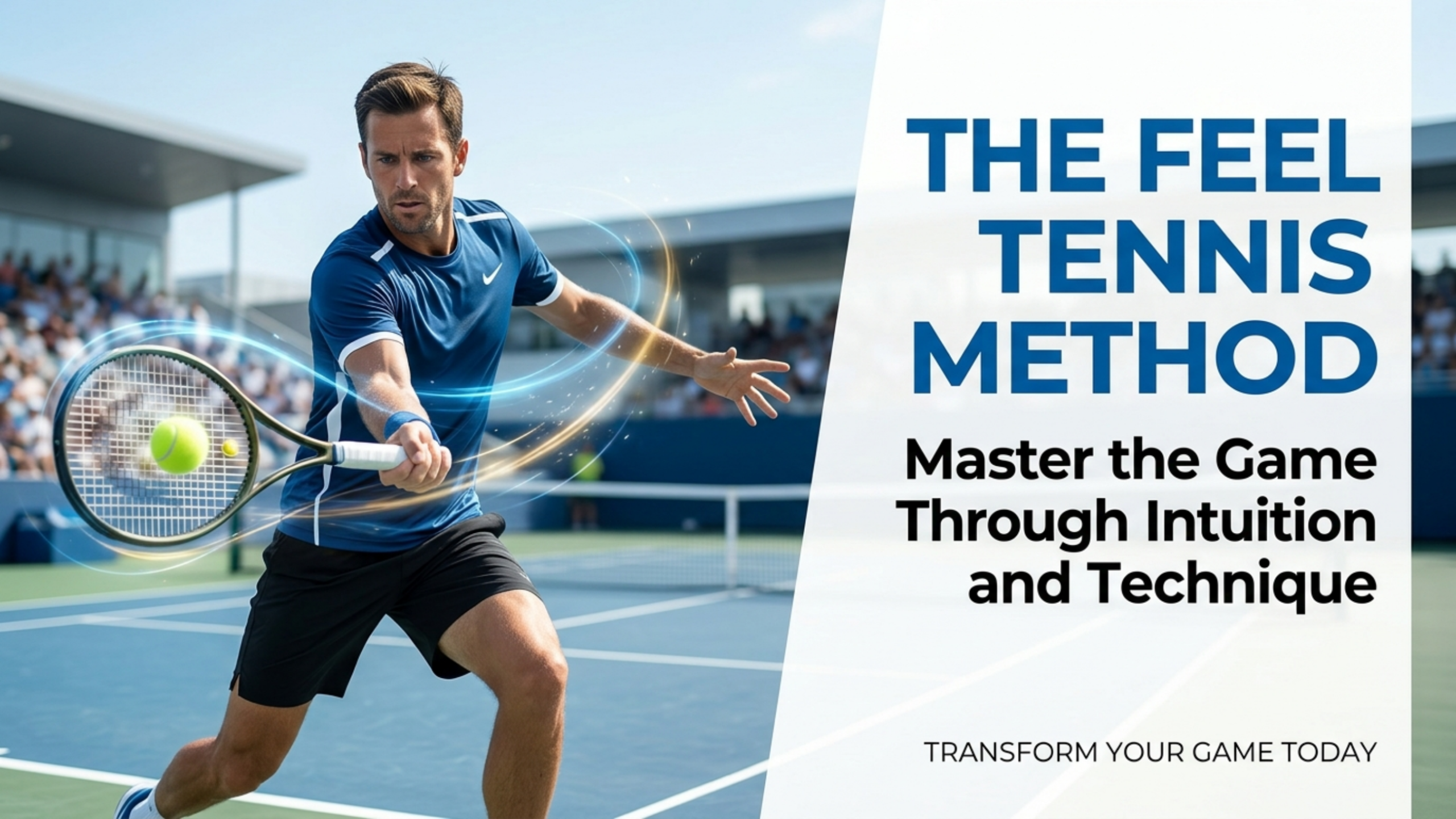
Transform your game by learning to feel the ball, not just hit it.
You’ve spent hours on the court, watched countless YouTube tutorials, and maybe even invested in private lessons. Yet, your game remains inconsistent, your strokes feel mechanical, and that powerful, fluid swing you see in the pros seems perpetually out of reach. The missing piece isn’t more drills or endless repetition of the same flawed mechanics. It’s a fundamental shift in how you think about the game itself. It’s about developing a deep, intuitive “feel” for the ball, your body, and the court.
This is the core philosophy behind the Feel Tennis Method, created by Slovenian coach Tomaz Mencinger. Instead of obsessing over the exact, robotic positioning of every joint, this approach prioritizes biomechanical efficiency and a sense of feel, allowing you to generate effortless power, pinpoint control, and unwavering consistency. It’s a method trusted by thousands of adult players worldwide who have used it to break through frustrating plateaus and finally master the game.
In this in-depth review, we’ll explore the origins, principles, and benefits of the Feel Tennis Method, and help you decide if it’s the key to unlocking your true potential on the court. If you’re ready to trade robotic mechanics for fluid, instinctive play, you can get started with the Feel Tennis Method here.
The Origin of the Feel Tennis Method: Meet Tomaz Mencinger
The Feel Tennis Method is the brainchild of Tomaz Mencinger, a certified tennis coach from Slovenia with a unique journey. His path to coaching wasn’t that of a former touring pro, but of a lifelong athlete and student of the game. As he writes on his blog, ball games were always fun for him from an early age, starting with table tennis at seven, then volleyball, and finally tennis at 14[reference:0]. He trained volleyball for 16 years at a near-professional level, always returning to tennis in the summers[reference:1].
Tomaz completed his first tennis coaching certificate at the age of 23, but his coaching philosophy didn’t stop developing there[reference:2]. He launched his first website, `tennismindgame.com`, in 2005, focusing on the mental and tactical side of the game[reference:3]. However, after years of observing tennis instruction, he noticed a significant gap in the market. He felt there was too much repetitive talk about mechanics and not enough focus on the core skills that truly separate good players from great ones: feel, timing, rhythm, and ball judgment[reference:4].
“There’s a ton of talk about technique and mechanics and not enough talk about feel, timing, rhythm and ball judgment – which I believe are the key skills if one wants to play tennis well.” — Tomaz Mencinger, Founder of Feel Tennis[reference:5]
This realization led to the birth of FeelTennis.net. Tomaz’s goal was to share insights into areas that are not so obvious but incredibly important for playing well[reference:6]. He has since coached many nationally ranked junior and ITF players and has developed a large following on his YouTube channel, “Feel Tennis Instruction,” where he shares his unique perspective[reference:7].
The Philosophy: Mastering Technique Through Intuition
At its heart, the Feel Tennis Method is a rejection of overly mechanical coaching. Many traditional methods focus on getting the player into a specific, “correct” position for every stroke, often leading to tension and a lack of adaptability. Tomaz argues that stroke technique needs to adapt to the situation you’re in and therefore can never be exactly the same[reference:8].
Instead, his methodology is to isolate different parts of the body so you have a reference “feel” and then gradually stitch them all together in the correct order of the kinetic chain[reference:9]. This creates a powerful, efficient, and repeatable stroke that is driven by your body’s natural biomechanics, not by forcing it into an unnatural position.
This approach is particularly effective for adult learners. As one review noted, Tomaz has years and years of dealing with adults, so he focuses on biomechanics. The many coaches out there that tell you to do this or that, without showing you what that feels like, will probably make it an exhaustive process[reference:10]. The Feel Tennis Method bridges that gap, turning abstract technical advice into tangible, physical sensations.
Key Principles of the Feel Tennis Method
The Feel Tennis Method is built on several core principles that set it apart from traditional coaching. These concepts form the foundation of Tomaz’s courses and video lessons.
1. The Kinetic Chain: Your Body’s Engine
Many players, especially recreational ones, “arm” the ball, using only their shoulder and arm for power. This is inefficient and leads to inconsistency and injury. The Feel Tennis Method teaches you to use your entire body as a kinetic chain, generating power from the ground up—through your legs, hips, core, and then finally into your arm and racket. One reviewer called Tomaz “the finest coach for helping you with kinetic chains”[reference:11]. By feeling the correct sequence of your body’s rotation, you unlock effortless power.
2. Feel-Based Drills, Not Just Repetition
Blind repetition reinforces bad habits. The Feel Tennis Method uses deliberate drills that are designed to help you feel a specific part of a stroke. For example, the “catch the racquet” drill for the forehand is used to unlock body rotation. Teaching players to catch the racquet in the follow-through will “unlock” their forehand power because it will unlock their body rotation[reference:12]. This provides a clear, tangible reference point for the correct finish position.
3. Balance and Stability
Being well-balanced while hitting a stroke is one of the most important parts of your tennis skills, as it allows you to play with consistency and power[reference:13]. Tomaz emphasizes that we must not lean and adjust with the upper body but instead do all the adjusting with our legs[reference:14]. This foundational skill is often overlooked but is critical for every shot.
4. Focus on Feel, Not Exact Technique
The core of the method is shifting your attention from the rigid, external mechanics of a stroke to the internal sensation of executing it correctly. This is why Tomaz breaks down strokes into 4 major “feels” of what to do with the body, arm, and wrist[reference:15]. By focusing on the feeling, your body learns to adapt to different ball heights, spins, and speeds naturally.
5. Simplification Through Progression
Complex strokes like the serve or a volley are broken down into smaller, manageable chunks. For instance, the backhand volley is taught through a clear 5-step guide covering the grip, split step, preparation, and the finish[reference:16]. This progressive approach prevents overwhelm and allows you to build your skills methodically.
What’s Inside the Feel Tennis Course?
The Feel Tennis Method is typically delivered as an online course. While the exact modules and pricing can vary, the program is designed to be a comprehensive system for mastering the game. Here’s what you can generally expect to find inside the membership area.
Core Stroke Modules
The course covers all the essential strokes in great detail, using the feel-based approach. This includes:
- Forehand: Learn to unlock effortless power and consistency through body rotation. The “catch the racquet” drill is a hallmark of this section[reference:17].
- Backhand: Both one-handed and two-handed backhands are covered, focusing on a fluid kinetic chain and clean contact.
- The Serve: A detailed breakdown of the serve biomechanics, including pronation, the trophy position, and specific drills for developing a powerful and accurate kick serve[reference:18].
- Volleys and the Smash: Learn the proper grip (Continental) and footwork for rock-solid volleys and an authoritative overhead smash[reference:19].
Video Library and Drills
The course is video-heavy, with high-definition footage and slow-motion analysis. Tomaz uses a variety of drills, from simple shadow swings to advanced ball-feeding exercises, to help you internalize the feel of each stroke. For example, serve drills range from serving from the service line to using obstacles to exaggerate the upward swing path for topspin[reference:20].
Tactical and Mental Game
While technique is the main focus, the course also touches on strategy and the mental side of tennis, including how to avoid overthinking on the court[reference:21]. It draws from Tomaz’s earlier work on `tennismindgame.com`, providing a well-rounded education.
Bonus Content
Some versions of the course include bonuses like a free “Forehand Power Course” to help you get started immediately, as well as downloadable guides and checklists[reference:22].
The program covers every aspect of the game, from groundstrokes to the serve and net play.
The Benefits of Training with the Feel Tennis Method
Students of the Feel Tennis Method report a wide range of benefits that go beyond just winning more matches. Here’s what you can expect to gain.
- Effortless Power: By learning to use your body’s kinetic chain, you’ll generate more power with less effort, saving your arm and energy for long matches.
- Unwavering Consistency: The focus on feel and repeatable swing paths leads to a more consistent ball strike, drastically reducing unforced errors.
- Improved Adaptability: Because you’re not locked into a rigid mental model of the perfect stroke, you’ll become better at adjusting to difficult shots, off-pace balls, and varying court conditions.
- A Cure for “Arming” the Ball: Many recreational players rely too heavily on their arm. This method teaches you to relax your arm and let your body do the work, leading to more fluid strokes[reference:23].
- Reduced Risk of Injury: Biomechanically efficient strokes put less strain on joints like the elbow, shoulder, and wrist, helping to prevent common tennis injuries like tennis elbow.
- Greater Enjoyment of the Game: Playing tennis becomes more intuitive and less of a mental struggle. You’ll find yourself in the “zone” more often, where the game feels effortless and fun.
Feel Tennis Method: Pros and Cons
Pros ✅
- Unique and Effective Philosophy: The focus on “feel” over robotic mechanics is a game-changer for many adult players.
- Expert Coaching: Tomaz Mencinger is a highly experienced and respected coach with a deep understanding of biomechanics.
- Structured and Progressive: The course is well-organized, allowing you to learn at your own pace in a logical order.
- Affordable: Compared to the cost of ongoing private lessons, an online course offers tremendous value.
- Lifetime Access: Once you purchase the course, you typically have unlimited access to all materials and future updates.
- Positive Student Feedback: Numerous testimonials praise the method for its clarity and effectiveness in fixing major technical flaws[reference:24].
Cons ❌
- Requires Self-Discipline: As with any online course, your success depends on your commitment to practice and apply the lessons.
- No In-Person Feedback: While the instruction is clear, you don’t have a coach physically present to correct your form. (However, you can film yourself for self-analysis).
- May Not Suit All Learning Styles: Some players may still prefer the hands-on, real-time corrections of a private coach.
- Pricing Information Not Always Transparent: Finding the current pricing for the full course on the website can sometimes require clicking through to a sales page.
Real Results: What Students Are Saying About the Method
The most compelling evidence for any method is the success of its students. Here’s what real players have to say about their experience with the Feel Tennis Method.
“Coach Tomaz is the finest coach for helping you with kinetic chains.”
“I came determined to fix my wonky forehand. From the baseline I tend to arm it, like many rec players do. Coach Tomaz is in my mind the finest coach for helping you with kinetic chains. His methodology is to isolate different parts of the body so you have a reference ‘feel’ and then gradually stitch them all together.”
— A student who traveled to Slovenia for in-person training[reference:25]
“The whole thing is so beautiful it confounds my opponents into submission.”
A forum user discussing Tomaz’s forehand principles, noting that his fluid, modern technique has become a significant advantage in matches[reference:26].
“Tomaz has a knack for finding the right word that will instill the proper mental image.”
A student reflecting on a five-day training session, praising Tomaz’s ability to communicate complex biomechanical concepts in an understandable way[reference:27].
Feel Tennis vs. Traditional Coaching: A Different Path to Mastery
It’s helpful to understand how the Feel Tennis Method differs from conventional tennis instruction. Traditional coaching often focuses on getting the student into the correct static positions for each stroke. Coaches might say “keep your elbow tucked in” or “rotate your shoulders more,” but they may not provide a way to *feel* what that rotation is supposed to be like.
Tomaz’s approach is different. He focuses on the correct sequence of biomechanics, which is different to most other coaches that care about visual results of the ball over what your body is supposed to be doing[reference:28]. Instead of saying “rotate your shoulders,” he might use a drill that forces you to catch the racquet, which naturally unlocks your body rotation. The method is about teaching the swing path in reverse by defining the start and finish position of the forehand[reference:29].
While traditional coaching has its place, the Feel Tennis Method is particularly well-suited for adult players who have struggled to overcome ingrained technical flaws. It provides a new, intuitive roadmap for improvement when other methods have failed.
Is the Feel Tennis Method Right for You?
- Adult Recreational Players: If you’re an adult learner who has struggled with “arming” the ball or inconsistent strokes, this method is ideal. It’s designed for adults who need to understand the *feeling* of a correct stroke[reference:30].
- Players in a Rut: If you’ve hit a plateau and feel your game isn’t improving despite your efforts, a new perspective on technique could be the breakthrough you need.
- Self-Analyzing Students: This course is perfect for players who are willing to film themselves, analyze their form, and work on drills independently.
- Budget-Conscious Players: If the cost of private lessons is prohibitive, this online course provides incredible value for a one-time fee.
- Competitive Juniors: While designed with adults in mind, the biomechanical principles are sound for any developing player seeking to build a world-class technique.
Final Verdict: Master the Game Through Intuition and Technique
The Feel Tennis Method is more than just an online course; it’s a paradigm shift in how to learn and play tennis. Tomaz Mencinger has successfully distilled years of coaching experience and biomechanical study into a system that prioritizes intuitive feel over rigid mechanics. For the countless adult players who have grown frustrated with the limitations of traditional coaching, this method offers a clear, effective, and liberating path forward.
The course’s strengths lie in its clear structure, expert instruction, and focus on drills that provide tangible, physical feedback. While it requires self-discipline, the potential payoff—effortless power, consistency, and a deeper enjoyment of the game—is immense. It’s an investment in your tennis that will pay dividends for years to come.
Rating: 9.1/10 — Highly recommended for any tennis player who wants to break free from mechanical, frustrating plateaus and learn to play with fluid, intuitive power.
Get instant access to the full Feel Tennis Method course and transform your game.
Ready to unlock the power of intuitive tennis?
Don’t let another year go by with a game that feels stiff and inconsistent. Join thousands of players who have revolutionized their tennis with the Feel Tennis Method. Get lifetime access to the complete course and finally experience the joy of playing with effortless power and precision.
🎾 ENROLL IN THE FEEL TENNIS METHOD NOW 🎾
Lifetime access • Proven method • Risk-free with a money-back guarantee