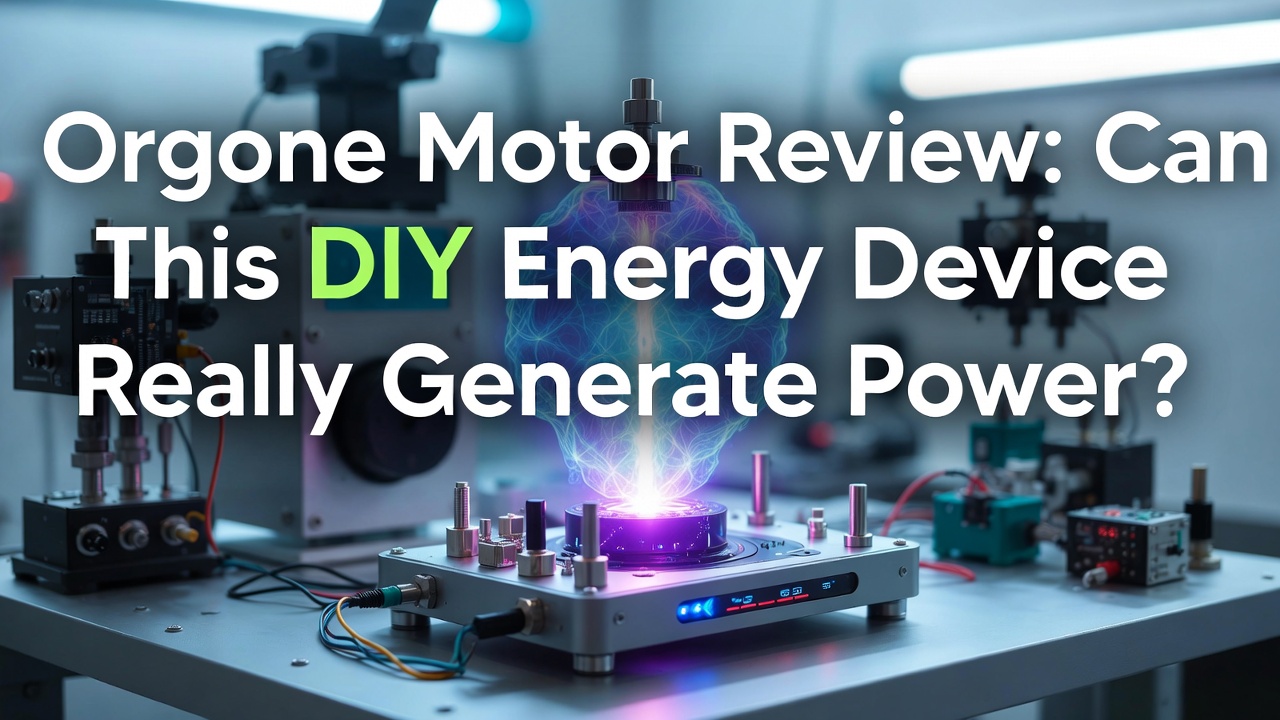
A typical DIY setup for the Orgone Motor experiment.
For decades, the concept of “free energy” has been relegated to the fringes of science. Whispers of suppressed technologies, mysterious devices, and inventors silenced by corporate interest have fueled the imagination of hobbyists and survivalists alike. Among the most talked-about (and controversial) devices in this niche is the Orgone Motor. Promising to harness ambient energy from the environment—sometimes called “orgone,” “ether,” or “zero-point energy”—this DIY project has gained significant traction online.
But in a world where we pay for every kilowatt-hour, the idea of a self-running motor seems too good to be true. Is the Orgone Motor a genuine breakthrough in energy generation, or is it simply a cleverly designed science experiment that produces more hype than horsepower? In this in-depth Orgone Motor review, we will dissect the claims, analyze the science (or lack thereof), and guide you on what to expect if you decide to embark on this build.
If you are ready to look beyond the standard narratives of energy production and explore the potential of DIY physics, this article is your starting point. We will also point you toward the most comprehensive resources available if you wish to acquire your own Orgone Motor kit and plans.
What Exactly is the Orgone Motor?
To understand the motor, we must first touch upon the concept of “Orgone.” The term was coined in the 1930s by psychoanalyst Wilhelm Reich, who claimed to have discovered a primordial, universal energy that he called Orgone. While Reich’s work was (and still is) heavily criticized and dismissed by mainstream physics, his ideas have persisted in alternative science circles. Modern proponents suggest that this energy can be captured, focused, and even used to perform mechanical work.
The Orgone Motor, as presented in modern DIY guides, is a device that supposedly taps into this ambient energy field. Typically, it consists of a specific arrangement of magnets, coils, and organic/inorganic materials (like steel wool and resin) layered in a way that is said to attract and condense orgone energy. This concentrated energy is then theoretically converted into a usable electrical current or rotational force, making the motor spin indefinitely without a conventional power source.
“The allure of the Orgone Motor is not just in the promise of free electricity, but in the radical idea that the universe is filled with a usable, inexhaustible energy source that we have simply ignored.”
The Mechanics: How Does It Claim to Work?
Most commercial guides for the Orgone Motor, such as the popular plans found in the Green Energy Guides, describe a build process that combines elements of traditional electrical engineering with metaphysical concepts. The core components usually include:
- The Rotor: A magnetized disc or wheel designed to spin freely on a bearing.
- The Stator/Coils: Copper wire windings that are intended to capture the energy fluctuations.
- The Orgone Accumulator: Layers of organic material (fiberglass, resin) and inorganic material (steel wool, metal shavings) which, according to Reich’s theory, attract, absorb, and radiate orgone energy.
- Capacitors and Diodes: To smooth out and capture the “pulses” of energy generated by the system.
The theory suggests that the orgone accumulator creates a gradient in the ambient energy field. The metal in the rotor and stator interacts with this field, causing the rotor to turn. As the magnets on the rotor pass the copper coils, they induce a current—just like in a standard generator. The difference is that the initial “push” to keep the rotor moving is not coming from a battery or the grid, but from the surrounding orgone field. This would classify it as a “over-unity” device (producing more energy than is put in), which violates the first law of thermodynamics in the conventional sense. This is the central point of contention in any serious Orgone Motor review.
A cross-section of the layered materials used in the construction.
The Orgone Motor Review: Separating Fact from Fiction
As with any topic straddling the line between science and pseudoscience, opinions on the Orgone Motor are fiercely divided. Let’s look at both sides of the coin.
The Proponents’ Perspective
Thousands of DIY enthusiasts claim to have built working models. They post videos online showing rotors spinning for days or weeks. They argue that mainstream science is either ignorant of these phenomena or actively suppressing them due to economic interests. For them, the Orgone Motor is a liberating technology. They point to the work of Nikola Tesla, who spoke of “radiant energy” and wireless power, as a precursor to this kind of device. In online forums, many users report that even if the motor doesn’t produce massive amounts of power, the orgone device itself seems to have positive effects on plant growth or human mood—though these claims are even harder to quantify.
The Skeptics’ Perspective
From a physics standpoint, the Orgone Motor is impossible. The laws of thermodynamics, which are the bedrock of modern engineering, state that energy cannot be created from nothing. Skeptics argue that any motion observed in these devices is due to one of three things: 1) Convection currents (warm air rising from the electronics or the builder’s hands), 2) Inadvertent battery power hidden in the circuit, or 3) The device slowly discharging a capacitor that was charged by the builder before the demonstration. They claim that no Orgone Motor has ever been demonstrated under rigorous, controlled, double-blind test conditions. Most of the videos, they argue, show the motor running down over time, proving it is simply a very inefficient standard motor running on stored energy.
Where does the truth lie? It likely depends on your willingness to challenge accepted scientific dogma. For the hobbyist, the value may not be in the energy output, but in the learning process. Building a motor from scratch, winding your own coils, and experimenting with magnetic fields is an incredibly rewarding educational experience. And who knows? Perhaps by following the detailed plans, you will stumble upon a resonance effect that others have missed. This is precisely why so many are eager to start their journey with a complete Orgone Motor building guide.
Building Your Own: The DIY Experience
If you have a soldering iron, a multimeter, and a healthy dose of curiosity, building an Orgone Motor is a fantastic weekend project. The parts are generally inexpensive and can be sourced from old electronics or hardware stores. The process involves precision: magnet placement is critical, coil winding must be neat, and the layering of the orgone accumulator must be exact.
Many builders report that the “aha!” moment comes not when the motor first spins, but when they begin to measure tiny voltage spikes across their capacitors that seem to have no conventional explanation. Whether these spikes are ambient RF noise picked up by the long wires (as a skeptic would say) or actual orgone energy (as a believer would say) is up for debate. The experience, however, is undeniably real.
To truly understand the phenomenon, you need detailed, step-by-step instructions. Vague forum posts and blurry YouTube videos only get you so far. You need the schematics, the materials list, and the specific build techniques that have reportedly worked for others. If you are serious about conducting this experiment properly, you should check out the resource that started it all for many builders. You can find the most comprehensive step-by-step Orgone Motor plans available online through this link.
Includes detailed diagrams, parts list, and video tutorials.
Practical Applications: What Can You Power?
This is the reality check in any honest Orgone Motor review. Even the most enthusiastic builders admit that you are not going to power your house with a single unit—at least, not yet. Most working models produce enough energy to light a single LED or slowly charge a small battery. The output is often measured in milliwatts.
However, proponents argue that this is just the beginning. They claim that scaling up the device, or building arrays of them, could yield more significant results. Others use them in “radionic” or “orgone therapy” contexts, where the energy itself—not the electricity—is the valuable commodity. They place the devices in their homes to improve the “vibrational quality” of the space, similar to how people use crystals or meditation.
For the average person, the immediate practical application is educational. It serves as a powerful conversation starter about energy, consciousness, and the limits of modern science.
Where to Find Reliable Information
Navigating the world of free energy devices is tricky. There is a lot of noise, misinformation, and outright scams. You need a source that provides clear, actionable information without the fluff. The Green Energy Guides has established itself as a reputable hub for these alternative energy projects. Their guide on the Orgone Motor is one of the most downloaded resources in the niche.
By accessing the guide, you get access to high-resolution diagrams, a complete materials list with sourcing tips, and access to a community of builders who can help you troubleshoot. Whether you are a seasoned electrical engineer or a complete newbie, having this roadmap is essential. Don’t waste weeks trying to piece together information from disjointed forums. If you want to see for yourself what this technology can do, the best starting point is to view the official Orgone Motor guide and diagrams here.
Final Verdict: Is It Worth It?
So, after this extensive Orgone Motor review, what is the conclusion? Does it really generate power?
Technically, by the standards of peer-reviewed science, the answer is no. There is no widely accepted proof that the Orgone Motor violates the laws of physics. It does not appear to be a viable source of grid-quality electricity—yet.
However, as an experiential device, the answer is a resounding “maybe.” Thousands of people have built them and observed anomalous behavior. They have seen motion that cannot be easily explained. They have measured voltages that seem to appear from nowhere. For the price of a few cups of coffee and a weekend of soldering, the Orgone Motor offers a hands-on exploration of the fringes of science. It forces you to question your assumptions about reality and energy.
If you go into this expecting to replace your local power grid, you will be disappointed. If you go into this with an open mind, a spirit of experimentation, and a desire to learn, you will find it one of the most fascinating projects you have ever undertaken.
The only way to truly know is to build one yourself. Don’t rely solely on my opinion or the opinion of skeptics. Gather the materials, follow the best plans available, and conduct your own experiments. The universe of energy might be bigger than we currently imagine.