Milsim vs. Standard FPS: How Deep Tactics and Strategy Set You Worlds Apart
Moving from Call of Duty to Arma isn’t just a change of game—it’s a change of mindset. Discover the core philosophical and mechanical differences that separate arcade shooters from military simulations, and learn the strategic skills that define the elite.
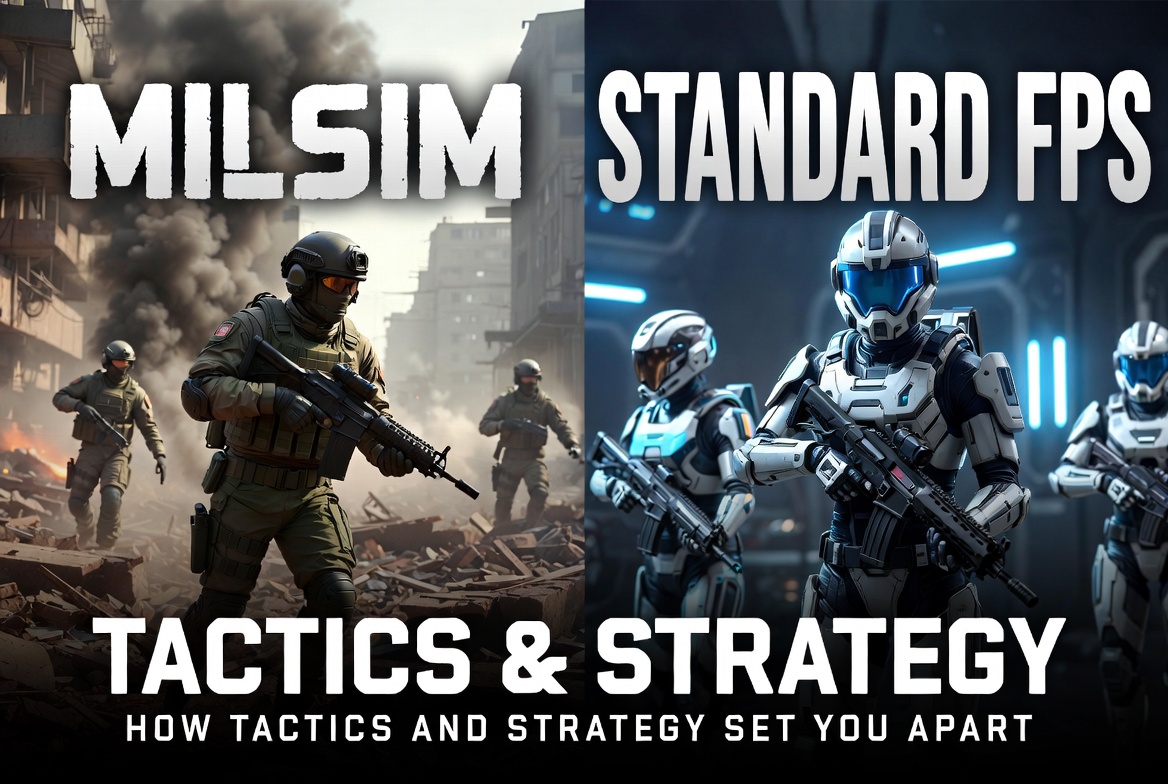
This isn’t about one game being “better” than another. It’s about understanding a different gaming philosophy. Standard FPS titles like Call of Duty or Battlefield (in its standard modes) are designed as tests of reaction time and mechanical skill, distilled into fast-paced, adrenaline-fueled matches. Milsim, or Military Simulation, shifts the focus. Here, the core challenge is a test of planning, teamwork, communication, and endurance [citation:1]. It’s the difference between a sprint and an orienteering marathon.
“Some Milsim players will go through an entire weekend using only a handful of bb’s, some none at all. There’s more patrolling, securing areas, communicating, setting up camp… It’s enough fun just being involved, especially with a good storyline.” – A Milsim participant’s perspective on the non-combat focus [citation:1].
This comprehensive guide will dissect the five key pillars that separate these two worlds. We’ll explore the mindset shift required, the immersion factors, and the team dynamics that make Milsim uniquely demanding and rewarding. If you’re looking to bridge the gap and master the art of tactical gameplay, understanding these fundamentals is your first, and most critical, mission.

1. The Core Philosophy: Action vs. Outcome
The most profound difference isn’t found in a game’s settings menu, but in the player’s head. The objective defines the approach.
Standard FPS: The Economy of Action
In mainstream FPS games, success is quantified instantly: K/D (Kill/Death Ratio), score per minute, match victory. The gameplay loop is tight and repetitive: spawn, seek engagement, win gunfight, repeat. The strategy is often moment-to-moment—which corner to check, which power-up to grab. It’s a game of efficiency where the fastest reaction and the best aim win the economic exchange of hit points. The narrative is simple (red team vs. blue team), and the stakes are low and reset every 10 minutes.
Milsim: The Calculus of Consequence
Milsim flips this script. Here, the avoidance of unnecessary contact can be a more successful strategy than seeking it [citation:1]. A single death or the loss of a key vehicle isn’t a minor setback; it’s a catastrophic loss of tickets (reinforcement points) or a mission-critical asset that can doom your side’s 90-minute campaign. As one Project Reality forum user noted, these games are “shooters with consequences,” where minimizing damage requires teamplay [citation:3].
The goal shifts from accumulation of points to the achievement of operational objectives: secure and hold this town for 30 minutes, destroy the enemy artillery battery, rescue the downed pilot behind enemy lines. Every engagement is weighed against its potential cost to the broader mission. This creates tension, patience, and a level of deliberate thought utterly foreign to the arcade shooter arena.
Standard FPS Mindset
- Goal: Maximize kills, minimize deaths, win round.
- Engagement: Actively sought, constant action.
- Pace: Fast, reflexive, high adrenaline.
- Cost of Death: Low. 10-second respawn timer.
- Paradigm: “See enemy, shoot enemy.”
Milsim Mindset
- Goal: Complete tactical objectives with minimal losses.
- Engagement: Calculated, often avoided if possible.
- Pace: Slow, methodical, punctuated by intense action.
- Cost of Death: Very High. Long respawn wave or permanent loss.
- Paradigm: “Is engaging this enemy worth risking our mission?”
2. The Weight of Reality: Immersion Through Mechanics
Standard FPS games use realism as a aesthetic layer—the guns look real, the explosions are loud. Milsim games bake realism into their core mechanics, directly impacting how you play.
| Gameplay Element | Standard FPS Approach | Milsim Approach | Impact on Play |
|---|---|---|---|
| Weapon Handling | Low recoil, high accuracy while moving, fast reloads. | Heavy recoil, significant accuracy penalty when moving, deliberate reload animations requiring management of partial magazines. | Encourages stationary, aimed shots. Suppressive fire becomes a valid tactic. Ammo conservation is critical. |
| Movement & Stamina | Unlimited sprint, quick strafing, bunny-hopping often effective. | Limited stamina, inertia/momentum affects turning, movement noise matters. “You can’t really simulate a real combat the best thing to do is slow the gameplay down” [citation:3]. | Movement must be planned. Rushing exhausts you, making you vulnerable. Stealth via slow movement is possible. |
| Communication & Awareness | Minimap with enemy red dots, 3D spotting, simple ping system. | No magical spotting. Reliance on verbal callouts (“enemy, infantry, bearing 220, near the tree line”), map markers placed by players, and direct visual identification. | Situational awareness is a skill you build, not a UI feature. Clear, concise communication is mandatory for survival. |
| Logistics & Sustainment | Non-existent or simplified (capture points to gain vehicles). | Central pillar of gameplay. Building Forward Operating Bases (FOBs), ferrying supplies with logistic trucks, managing ammunition and construction points [citation:3]. | Teams need dedicated logistic players. Frontline success is dictated by supply line security. The battlefield is dynamic and built by players. |
These mechanics create what fans call the “authentic experience” [citation:2]. It’s not about being a perfect simulation of war (an impossible task with current technology [citation:3]), but about creating a system where real-world tactical principles yield the best results. Flanking, covering fire, bounding overwatch, and secure communication aren’t just fun roleplay—they are the most effective tools for victory.

3. The Social Engine: From Lone Wolves to Cogs in a Machine
In a standard FPS, a team is a collection of individuals sharing a goal. In Milsim, a team is an organism with specialized cells, and communication is its nervous system.
Standard FPS Teamplay
Cooperation is beneficial but not strictly necessary. A highly skilled player can “carry” a team. Communication is often informal, focused on calling out enemy positions or planning a simple push. Roles are soft-defined by weapon choice (sniper, assault) but are largely interchangeable.
Milsim Unit Cohesion
This is where Milsim truly diverges. Success is impossible without active, structured cooperation. Games are built around a clear chain of command, often featuring:
- Squad Leaders: The linchpins. They communicate with the overall Commander, receive strategic objectives, and direct their 9-man squad tactically. They place rally points for respawns and build FOBs.
- Specialized Roles: Players choose kits with specific, non-interchangeable functions: Automatic Rifleman (provides suppression), Medic (the only one who can heal effectively), Anti-Tank, Engineer, Machine Gunner, Crewman (for vehicles).
- Integrated Combined Arms: Armor squads (tanks), aviation squads (helicopters), and mortar teams must coordinate with infantry to be effective, rather than operating as independent kill-streak machines.
The forum discussion on Project Reality highlights this perfectly: it’s a game that simulates “coordination, teamwork and communication” above all else [citation:3]. A squad moving in silence is a squad about to be ambushed. A tank rolling into a town without infantry support is a tank about to be destroyed by a lone anti-tank soldier. Your individual skill matters, but only insofar as it serves the group’s objective.
The Communication Chasm
Imagine the difference in comms:
FPS: “He’s on the right!”
Milsim: “Contact, infantry! Bearing 095, approx 150 meters, near the two-story white house with the broken chimney. Engaging. Squad, move to cover along the west wall.”
The latter is precise, actionable, and follows a common format (What, Where, How Far, What Next). Learning this language is a key skill in the MILSIM Gaming Tactics and Strategy Guide.
4. More Than a Game: Commitment, Gear, and Culture
The differences extend beyond the digital screen, influencing the community, required investment, and even the hardware used.
Time & Session Length
FPS: Matches last 5-15 minutes. You can hop in and out casually.
Milsim (Digital): Matches (often called “rounds” or “missions”) last 60-120 minutes. Leaving mid-game severely hurts your team.
Milsim (Physical – Airsoft/Paintball): Events can last an entire weekend, with no “safe zone” breaks, requiring players to camp, eat, and live in the field [citation:1]. This emphasizes endurance and self-sufficiency.
Gear & Authenticity
FPS: A gaming PC/console and a headset. Cosmetic skins are for personal expression.
Milsim (Digital): Often benefits from specialized peripherals like head-tracking, large maps on second monitors, and high-quality microphones.
Milsim (Physical): Heavily emphasizes authentic uniforms, realistic weapon replicas, plate carriers, radios, and night-vision gear to enhance immersion [citation:2]. While this can seem elitist, proponents argue it enhances team identification and the tactical experience [citation:1].
Learning Curve & Community
FPS: Steep initial skill curve that plateaus. Community can be broad but often toxic/casual.
Milsim: A sheer cliff of knowledge. You must learn game mechanics, radio protocol, map navigation, and teamwork principles just to be functional. The community is generally older, more dedicated, and expects a baseline of cooperation. New players (“newbies”) are often guided if they ask for help.
This level of commitment creates a different social contract. In an FPS, you play for yourself. In a Milsim, you have a responsibility to your squad. Showing up unprepared, not communicating, or “memeing around” is seen as disrespectful to the dozens of other players investing their time in a serious endeavor.
5. The Bridge: How to Transition and Why You Should
So, you’re intrigued by the depth of Milsim but intimidated by the barrier to entry. How do you cross the chasm?
Start with “Tactical Shooters” (The Middle Ground)
Recognize that it’s a spectrum. Not every game is a hardcore simulation like Arma 3 (which some argue is a “military sandbox” more than a pure sim [citation:3]). There are excellent “tactical shooters” that blend elements of both worlds:
- Hell Let Loose / Squad / Post Scriptum: These are often the perfect gateway. They enforce teamwork and realistic ballistics but have slightly more accessible mechanics and shorter (but still long) matches than full-scale sims.
- Ready or Not / Ground Branch: Focus on CQB (Close Quarters Battle) and small-team tactics, often against AI. Excellent for learning room-clearing and precise communication without the scale of a 50v50 battle.
The Project Reality mod itself was described in its forum as bridging “the gap between milsim and FPS tactical in a way that no other game can” [citation:3]. Look for these bridge games.
Embrace the Learner Mentality
Your FPS reflexes will help, but you must suppress the urge to run and gun. Your first priority is to:
- Find a Newbie-Friendly Unit/Clan: Don’t start solo. Look for gaming communities that advertise training for new players. This is the single fastest way to learn.
- Start with a Basic Role: Pick Rifleman or Medic. These are always needed, and their tasks are straightforward (shoot, heal). Avoid specialized kits like Squad Leader or Anti-Tank until you understand the flow.
- Listen and Communicate: Even if you just say “copy” when given an order. Use your microphone. Ask questions before the match starts or during lulls.
- Learn the Language: Understand terms like “bearing” (compass direction), “FOB” (Forward Operating Base), “contact” (enemy sighted), “bounding” (moving under cover).
Why Make the Effort?
The payoff is a gaming experience unlike any other. The victories are earned, not given. The stories that emerge are not about your amazing kill streak, but about the time your squad held a defensive point against overwhelming odds through perfect coordination, or the tense, 20-minute infiltration mission where you never fired a shot but secured the victory. It provides a sense of camaraderie and accomplishment that fleeting matchmaking wins rarely match. To accelerate this journey and build a solid tactical foundation from day one, a resource like the MILSIM Gaming Tactics and Strategy Guide (The 3PS Battle Guide) can be invaluable, providing structured knowledge on formations, command structure, and scenario-specific strategies.

Conclusion: Two Valid Worlds, One Deeper Challenge
The choice between Milsim and standard FPS isn’t about selecting the “real” way to play shooters. It’s about choosing the kind of challenge you crave. The standard FPS is a thrilling arena of instant gratification and skill-testing combat. It’s accessible, fast, and endlessly replayable.
Milsim, however, offers a different reward: the satisfaction of complex problem-solving, the weight of meaningful consequence, and the powerful bond of functioning as part of a well-oiled team. It asks more of you—more time, more patience, more brainpower, and more social effort. In return, it gives you stories that feel earned, victories that taste sweeter, and a strategic depth that can keep you engaged for thousands of hours.
If you’ve ever felt that shooters have become predictable, or if you long for a game where your mind matters as much as your aim, then the world of tactical simulation is waiting. Mute your microphone, check your bearing, and move out. The mission is just beginning.
Ready to Command the Battlefield?
Stop being a soldier. Start being a strategist. The MILSIM Gaming Tactics and Strategy Guide (The 3PS Battle Guide) is your comprehensive field manual for mastering the art of tactical gameplay. Go beyond basic shooting and learn the proven systems for squad leadership, communication, map strategy, and combat roles that will make you an asset to any team.
Download Your Tactical Guide Now >>