
In the modern game of golf, guessing distances is a relic of the past. The right club selection, rooted in precise yardage, is the bedrock of consistent scoring. This is where the golf rangefinder has become as essential as a putter in your bag. But with a market flooded by options from premium brands like Bushnell and Nikon to a sea of budget-friendly models, how do you decipher which features truly impact your game?
Enter the MGS Eagle Eye Rangefinder, a device that has generated significant buzz by packing high-end features into an accessible package. This comprehensive guide will demystify the critical features of any quality rangefinder—accuracy, slope compensation, stabilization, target acquisition, and durability—and use the MGS Eagle Eye as our case study. We’ll explain not just *what* these features do, but *why* they matter to your scorecard, and see how this contender stacks up in the real world.
1. The Non-Negotiables: Core Accuracy & Measurement Speed
Laser Precision: The Foundation of Trust
At its heart, a rangefinder is a laser measurement tool. The most critical specification is its accuracy, typically stated as +/- 1 yard. This might seem trivial, but on a 150-yard approach, a 2-yard error can mean the difference between a birdie putt and a bunker visit. Premium models achieve this through high-quality optics and fast, precise laser diodes.
The MGS Eagle Eye claims this industry-standard +/- 1-yard accuracy. In practical terms, this means when it reads “147 yards,” you can trust the flag is between 146 and 148 yards away—more than enough precision for any amateur or professional golfer.
Need for Speed: Scanning vs. Pin-Seeking
Measurement speed is often overlooked. A slow rangefinder forces you to hold the unit rock-steady for an awkwardly long time. Faster models provide near-instant feedback. The Eagle Eye utilizes what’s often called “First Target Priority” or a “Pin-Seeker” mode. Its advanced processor filters out background clutter (like trees) and quickly latches onto the nearest solid object—ideally, the flag.

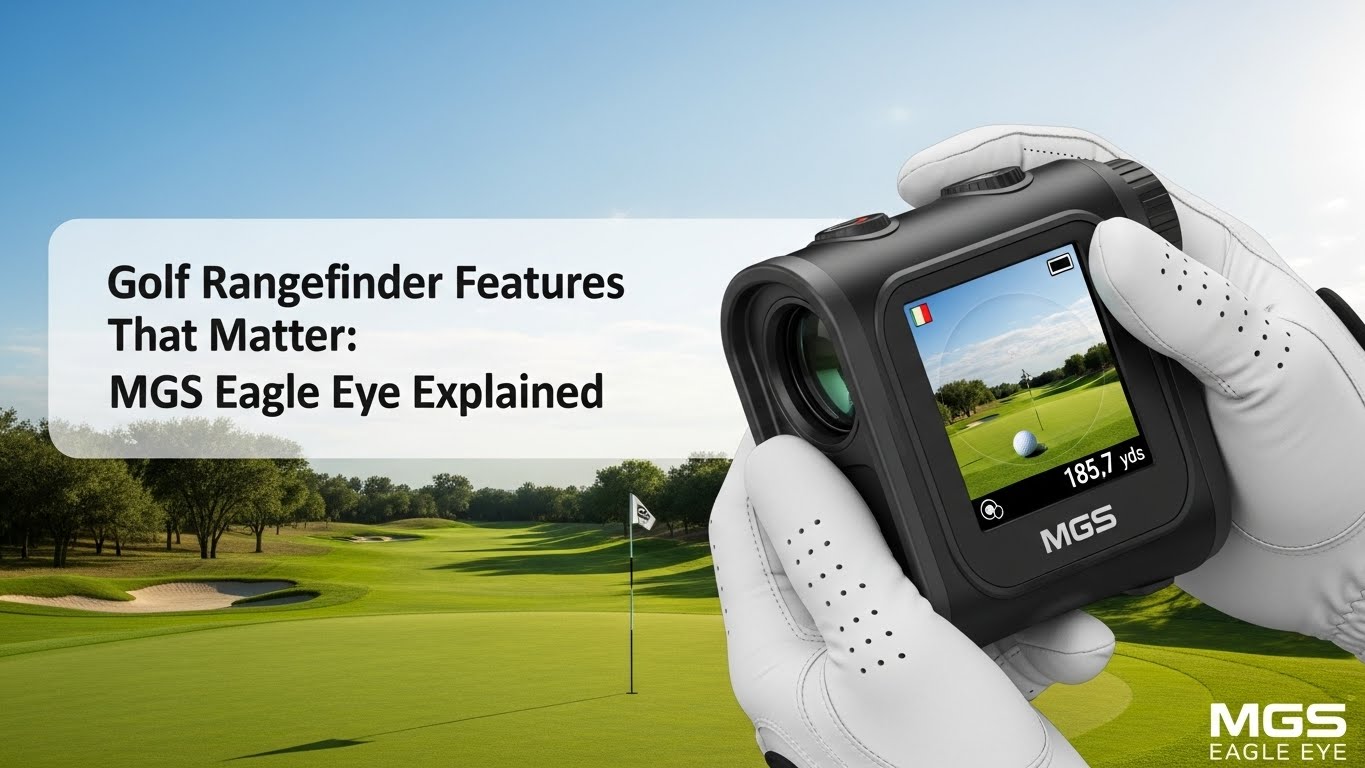
The view through a quality rangefinder: clear, magnified, and designed for one job.
2. The Intelligent Edge: Slope Compensation Technology
This is the feature that separates basic devices from game-planning tools. Slope compensation calculates the angle between you and your target and adjusts the “line-of-sight” distance to provide the “plays-like” distance.
Example: A flag is 150 yards away, but it’s 30 feet below you. A basic rangefinder says “150.” A slope model calculates the effective distance, accounting for the downhill, and tells you it will play more like 142 yards. This is crucial for club selection.
The MGS Eagle Eye Rangefinder features a tournament-legal slope switch. With a simple toggle, you can enable slope for practice and casual rounds to learn true distances, and disable it for sanctioned competition, ensuring compliance with USGA rules.
3. The User Experience: Stabilization, Vibration & Clarity
Steady Your Hand: The Importance of Stability
A shaky hand leads to a shaky reading. Higher-end models incorporate some form of image stabilization to minimize the effect of hand tremors. While the Eagle Eye doesn’t have the advanced gyro-based stabilization of a $500 unit, its ergonomic design and “fast-acquire” technology help users get a stable lock quicker, reducing the time you need to hold it perfectly still.
Confirmation You’ve Locked On: Haptic Vibration
This is a standout feature often reserved for premium tiers. When the rangefinder’s Pin-Seeker mode successfully isolates and locks onto the flag, the unit gives a short, sharp vibration (haptic feedback). This tactile “jolt” confirms you have the correct target without having to look away from the eyepiece. It’s an invaluable feature in low light or against busy backgrounds, and its inclusion in the Eagle Eye is a major selling point.
Crystal Clear Optics: Multi-Coated Lenses
A bright, clear view is non-negotiable. The Eagle Eye boasts 6x magnification (the golf standard) with fully multi-coated lenses. This coating reduces glare and increases light transmission, making the image sharper and brighter, especially on overcast days or in early morning light.
4. How Does the Eagle Eye Stack Up? A Real-World Comparison
| Feature | MGS Eagle Eye | Premium Model (e.g., Bushnell Pro X3) | Basic Budget Model |
|---|---|---|---|
| Accuracy | +/- 1 yard | +/- 0.5 yard | +/- 1-2 yards |
| Slope with Switch | YES | YES | Sometimes, rarely with a switch |
| Vibration Confirm | YES | YES | NO |
| Stabilization | Ergonomic / Fast Acquire | Advanced Gyroscopic | Minimal / None |
| Price Point | Mid-Range / Value | Premium ($400-$600) | Budget ($100-$200) |
The Verdict: The MGS Eagle Eye doesn’t win on every spec against the absolute top tier, but it strategically includes the three most impactful features for most golfers—slope, vibration confirmation, and solid accuracy—at a fraction of the cost. It occupies a powerful “value flagship” position.
5. Who Is The MGS Eagle Eye Rangefinder For?
The Perfect Fit ✅
- Serious golfers seeking slope and pro features without a $500 price tag.
- Players who frequently play hilly or unfamiliar courses.
- Those who value the confidence of haptic vibration feedback.
- Golfers wanting a USGA-legal device for tournament play (with slope off).
May Need To Look Elsewhere
- Golfers who only play flat, familiar courses and need basic yardage.
- Professionals or low-handicappers who demand absolute maximum stabilization and 0.5-yard precision.
- Those who prefer integrated GPS with course maps over laser targeting.

Ultimately, the MGS Eagle Eye Rangefinder represents a significant leap in value-for-money. It focuses the budget on the features that directly improve decision-making and confidence—accurate slope calculation and confirmed targeting—while trimming costs on areas like extreme stabilization that many amateurs won’t fully utilize. For the vast majority of golfers looking to invest in their first serious rangefinder or upgrade from a basic model, it presents a compelling, feature-rich case that can legitimately lower scores.
Ready to Game-Changing Precision?
Stop guessing and start knowing. Experience the confidence of slope-adjusted distances and haptic target confirmation.
Click below to visit the official offer for the MGS Eagle Eye Rangefinder. See current pricing, full specifications, and how it can become the most valuable club in your bag.
Get the MGS Eagle Eye Rangefinder
Disclosure: This article contains affiliate links. If you purchase through the link above, we may earn a commission at no extra cost to you. This supports our independent testing and review process. We only recommend products we believe offer genuine value to golfers.